A New Benchmark for Energy Conservation and Emission Reduction: Mini Fan's Low Energy Consumption and High Efficiency Gain Market Favor
Against the backdrop of accelerated global progress towards carbon neutrality, energy conservation and emission reduction have shifted from policy-driven to a core demand of the consumer market. As a representative of portable cooling devices, the Mini Fan, with its groundbreaking low-energy design and intelligent technological innovation, is reshaping the small appliance market with an average annual growth rate of 35%. From airport waiting areas to outdoor campsites, from office desks to student desks, this device, only one-fifth the size of a traditional fan, is penetrating various aspects of modern life as an "invisible energy-saving guardian."
Technological Breakthrough: System-Level Optimization Reconstructs Energy Efficiency Boundaries
Traditional mini fans have long been constrained by the technological path of "component efficiency improvement," with the energy efficiency of core components such as compressors and heat exchangers approaching physical limits. The new generation of Mini Fans, through the introduction of an AI adaptive control system, achieves a leap from single-component optimization to intelligent control of the entire system. Its dynamic load prediction algorithm can analyze ambient temperature, humidity, and user behavior patterns in real time, automatically adjusting refrigerant flow and motor speed. Laboratory data shows that this technology enables stable operation of the device within an ultra-wide temperature range of -35℃ to 60℃, with an overall energy efficiency (APF) exceeding 6.2 W·h/(W·h), saving over 40% more energy than traditional models.
At the manufacturing level, the breakthrough in miniaturized piezoelectric fan technology has opened up new paths for device miniaturization. By generating directional airflow through the high-frequency vibration of piezoelectric ceramic plates, the traditional motor-bearing structure is completely eliminated, not only reducing the device thickness to less than 3 cm but also achieving zero mechanical noise operation. Tests by a leading manufacturer show that its piezoelectric heat dissipation module, under continuous operation, reduces power consumption by 82% compared to traditional fans, while increasing heat dissipation efficiency by more than 3 times. This "silent revolution" has led to the widespread application of Mini Fans in noise-sensitive environments such as libraries and conference rooms.
The innovation of Mini Fans is not only reflected in technical parameters but also in its redefinition of the application boundaries of portable cooling devices. Addressing the energy consumption pain points of large public buildings, a company has developed a modular array system that enables the coordinated operation of hundreds of devices through wireless networking technology. In a pilot project at Beijing Daxing International Airport, the system automatically adjusts the airflow to different areas based on passenger density, reducing overall air conditioning energy consumption by 28% while keeping indoor temperature fluctuations within ±0.5℃.
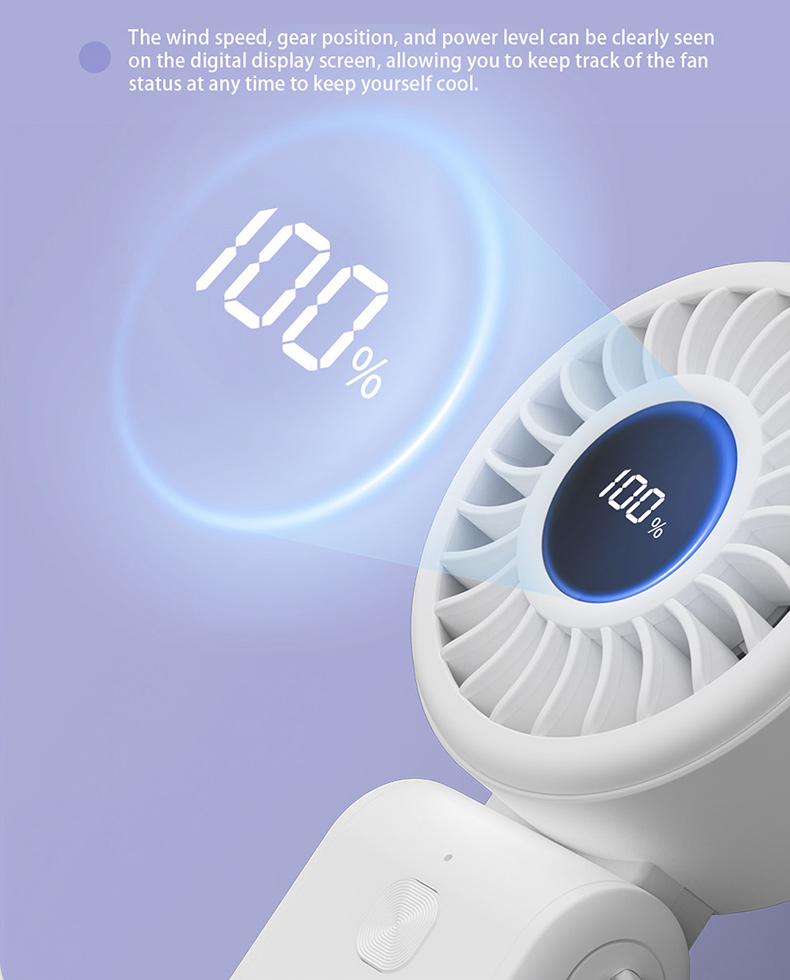
In the consumer market, the three-state switching design has become key to product differentiation. Through innovative applications of damping hinges and magnetic structures, the new generation of devices can quickly switch between vertical, horizontal, and hanging modes, adapting to various usage scenarios such as desktops, bedside tables, and backpacks. A user survey on an e-commerce platform shows that models supporting 100 levels of stepless speed adjustment and real-time power display have a 67% higher repurchase rate than basic models, with outdoor workers and commuters accounting for 41% of these repurchases.
Industry Upgrading: Green Manufacturing Fosters New Value Chains
The explosive growth of Mini Fans is forcing the entire industry chain to transform towards low-carbon practices. In the raw material stage, the application of bio-based plastics and recycled aluminum has significantly increased. One manufacturer, by using sugarcane bagasse extract to manufacture the shell, has reduced the product's carbon emissions over its entire lifecycle by 55%. On the manufacturing side, digital twin technology enables precise energy consumption control. One smart factory reduced equipment idling time by 73% through virtual commissioning, lowering unit product energy consumption to 0.08 kWh.
The combined effect of policy-driven growth and market demand is accelerating the elimination of outdated production capacity. According to the "Technical Specification for High-Efficiency Refrigeration Rooms," new public buildings must use Class 1 energy-efficient air conditioning equipment starting in 2026, providing a policy advantage for Mini Fan's expansion in the engineering market. Meanwhile, consumer attention to "energy efficiency labels" continues to rise. Data from an e-commerce platform shows that sales of products with the China Energy Conservation Association certification mark increased by 210% year-on-year, with high-end models with an APF value exceeding 6.0 accounting for 38%.

Future Vision: Driven by Intelligence and Integration
Looking ahead to 2027, Mini Fan will enter the "intelligent ecosystem" development stage. Through deep integration with IoT platforms, the equipment can automatically connect to building energy management systems, achieving synergistic optimization with photovoltaic power generation and energy storage devices. A certain concept product has showcased the "photovoltaic-storage-direct-flexible" technology path: its top solar panel generates enough power to meet 8 hours of daily operation, while the built-in energy storage module allows for continuous operation for 36 hours off-grid.
Regarding integrated health functions, the widespread adoption of nano-level air purification modules and negative ion generators has upgraded the Mini Fan from a simple cooling device into a miniature air management terminal. Tests by a research institution show that models equipped with HEPA filters achieve a PM2.5 filtration efficiency of 99.97%, while the addition of UV-C germicidal lamps increases the removal rate of airborne bacteria to 98.6%.
As energy conservation and emission reduction transform from a social responsibility into a business opportunity, the rise of the Mini Fan confirms a truth: the deep integration of technological innovation and green development can not only create economic value but also define the future of the industry. In this quiet energy revolution, every small innovation is propelling humanity towards a sustainable world.